Ranges · Los Angeles
Wolf range repair for all three kinds of range
Three different machines sell under the name Wolf range — all gas, dual fuel and induction — and no two of them fail in quite the same place. We sort out all three in kitchens around Los Angeles; $89 pays for our trip and is folded into the repair bill, and the real number for the fix is spelled out once the range has been opened up and measured, never earlier.
4.8 of 5 from 187 reviews About our reviews
- Call 24/7(213) 652-7030
- Pick a daytime slotBook a visit
- Per visit, credited to the repair$89
- House calls, every day8–6
Said plainly
Who does Wolf range repair in Los Angeles?
LA Wolf Range Repair, an independent shop that only travels to homes, fixes Wolf gas, dual fuel and induction ranges anywhere from the Palisades over to Hancock Park and up into the Valley. Phone (213) 652-7030 — the line is staffed 24/7; technicians roll out 8 AM–6 PM daily, and a same-day slot is yours if one is still free on the board.
Seven complaints a Wolf range makes
Almost every range call we take sounds like one of these. Jot down which burner, which oven setting and roughly when it began — a two-line note on the fridge saves real time once a technician is standing at your stove.
-
You notice
Tick-tick-tick from one burner, yet no flame shows up
Usually behind it
A cap knocked askew, an electrode still damp or caked from a pot that boiled over, or a spark module firing happily while it fails to register that a flame exists
-
You notice
Lazy flames with orange-yellow tips that lick the pan instead of sitting tight and blue
Usually behind it
Ports packed with dried sauce, a cap that rides off-center, or an air-to-gas ratio knocked out of line — occasionally the leftover of a natural-gas-to-propane swap done halfway
Read the repair page -
You notice
Turn the knob to its lowest mark and the tiny ring of flame winks out
Usually behind it
On a dual-stacked burner the bottom tier carries the simmer; if its little ports are half-plugged, or the cap tilts, that gentle flame has nothing stable to hang on to
-
You notice
Preheat drags on and on, or the oven tops out well short of the dial
Usually behind it
On an all-gas range, sluggish oven ignition; on dual fuel and induction models, a bake element gone open, a lazy sensor or a sticky relay
Read the repair page -
You notice
Sheet pans come out scorched along the back edge and blond at the front
Usually behind it
A convection fan that no longer spins, its heating ring burned through, or a probe telling the board a temperature that isn't true
-
You notice
Buttons and display go deaf, blink, or throw up a fault message
Usually behind it
Cleaning spray that crept behind the panel, a breaker that tripped quietly, or trouble on the electronic board itself
-
You notice
There's a smell of gas near the stove
Usually behind it
That is a safety matter first, a repair a distant second — scroll to the red gas warning on this page before touching anything
Gas, dual fuel or induction: what fails on each
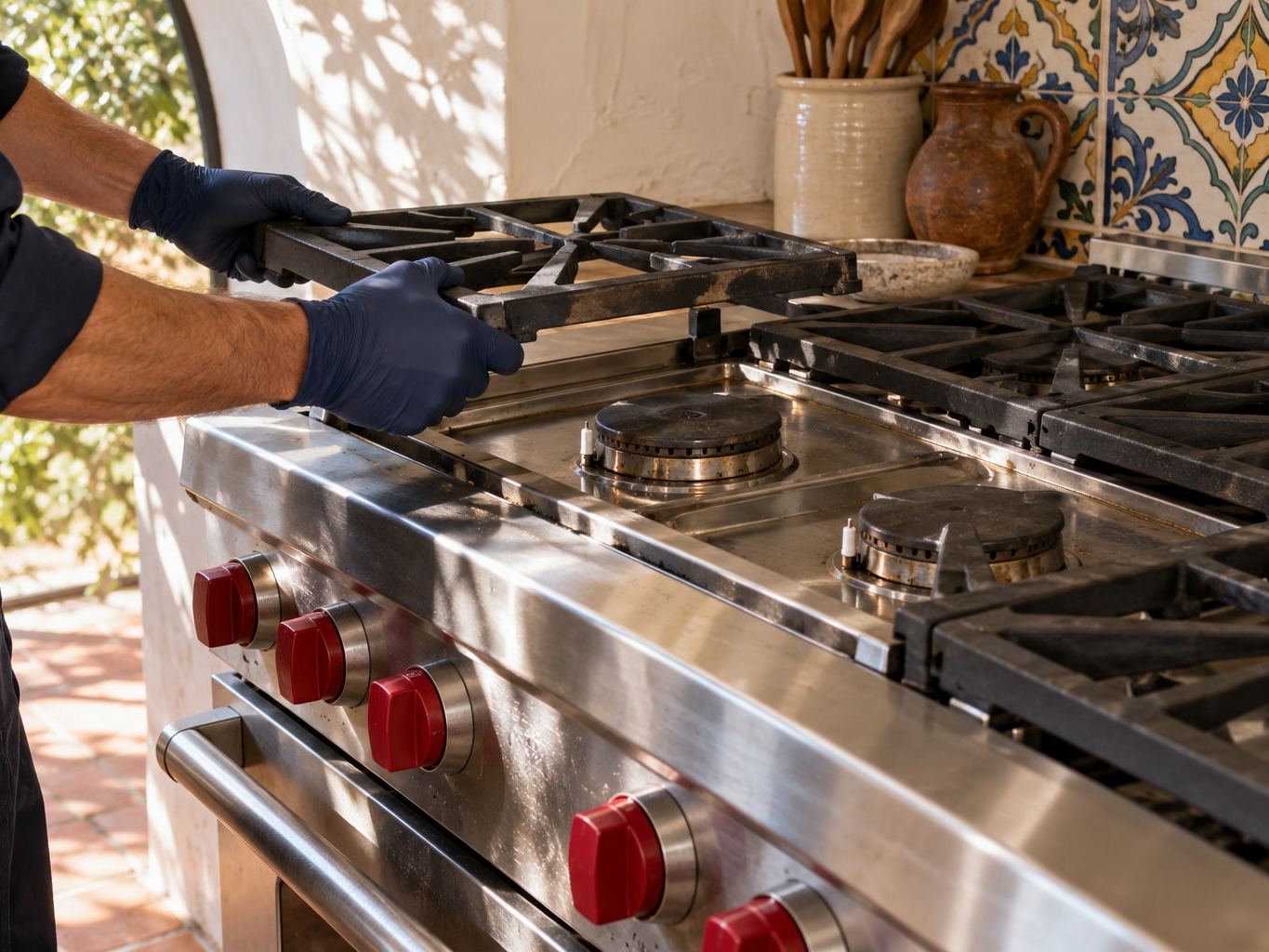
Quick way to tell yours apart: cast-iron grates over flames mean a gas top, a flat sheet of black glass means induction. Grates on top plus an electric oven underneath is dual fuel. Still unsure? The model plate or the paperwork from the install answers it, and knowing the type up front lets the technician bring the right questions.
Which parts get attention on each style of Wolf range
| Style | Up top | Down below | Usual opening move |
|---|---|---|---|
| All gas | Dual-stacked sealed burners, electrodes, the spark module, individual burner valves | Gas-fired oven: its ignition, safety valve, temperature probe, convection fan | Watch each flame at full and at simmer, then time how the oven climbs |
| Dual fuel | Identical gas burners and spark circuit to the all-gas model | Electric oven: bake and broil elements, fan with its own heating ring, probe, control board | Spark circuit first, then resistance checks on elements and relays |
| Induction | Copper coils under glass, the power electronics that drive them, a cooling fan, touch controls | Electric oven, laid out much like the dual fuel one | Is the fan moving air across the boards; which zone quits and with which pot |
| Gas or dual fuel with griddle or charbroiler | One more burner hiding under the plate or grate, with its own electrode and valve | Same as the matching range style | Reliable lighting and heat spread from corner to corner of the plate |
Said plainly
Why won't my Wolf range burner ignite?
Usually the cap has been nudged off its seat, or the electrode is still wet or crusted after a boil-over, so the spark jumps somewhere useless. Give it time to dry, set the cap down flat, and brush the ports gently. When it keeps ticking with no flame, or all burners tick together, the module or a knob switch is the suspect.
How we work through a range on site
Same sequence on every visit, Pacific Palisades or Hancock Park, so nothing is swapped on a hunch and you are never surprised by the bill.
-
Let the range show us
You describe what you've been living with; then we cook nothing but test everything — each burner wide open and turned right down, the oven on plain bake and again with the fan.
-
Read the numbers
Spark timing, flame shape on both tiers, real cavity temperature on our own thermometer, voltage at each element, and what the probe is reporting back to the board.
-
Name the fault and its price
Before a screw turns you hear what broke and exactly what fixing it costs. $89 buys the whole trip, not one appliance — have us glance at the wall oven or hood while we're in the kitchen and it's still that single trip charge. Say no thanks and that charge is the only thing on the invoice.
-
Fix what the readings point at
We change or adjust just the parts the tests implicate. When something must be ordered in, you know right then, and a second appointment gets pencilled in together.
-
Put the whole range through its paces
Every burner lights and holds a whisper of flame, the oven lands on its set temperature, the controls answer. Then you get a plain-English walk-through of what changed.
Smell gas? Out first
Gas smell at the range? Get out, then call
Never go hunting for the source of a gas odor yourself. Hands off the burner knobs, light switches, thermostat and anything else that might throw a spark. Walk everyone — pets too — out of the house, and only from the sidewalk or the yard phone the gas utility's emergency number or 911. We come once the gas side is declared safe; the range can wait.
- No matches, lighters or candles, and don't start a car in an attached garage
- Hold off on any phone call until you're standing outdoors
- Head back inside only after the utility crew or firefighters clear the house
Range myths that cause repeat visits
-
You may have heard
A burner cap is basically a lid — drop it on however it lands.
What actually happens
That cap is what shapes the flame. Sitting crooked on a dual-stacked burner, it chokes the lower ring, throws yellow tips and blocks the spark from finding gas. Seat it so it lies flat and doesn't wobble under a fingertip.
-
You may have heard
Endless ticking proves the igniter has died.
What actually happens
Far more often the igniter is healthy but damp, or moisture worked its way into the switch behind a knob during a wipe-down. Buying a new igniter without testing seldom quiets anything.
-
You may have heard
Slow oven? Just crank the dial past the recipe.
What actually happens
Overshooting the setting can't revive a weak element or correct a drifting probe; it simply torches the following batch when the heat finally arrives. A cheap oven thermometer tells you whether the oven or the dial is lying.
-
You may have heard
Induction means sealed electronics, so a fault means a new range.
What actually happens
Induction tops carry serviceable pieces — the cooling fan, power boards, individual coils, the touch strip. Proper diagnosis points to the one that quit and puts a number on fixing it.
Said plainly
My Wolf dual fuel range oven is not heating but the burners work — why?
Dual fuel means gas flames up top and an all-electric oven below, so happy burners with a cold oven aim suspicion at the electrical side: an element that has burned open, a probe that failed, a relay that stopped closing, or the oven's breaker in your panel. Check that breaker; if it's fine and the oven still won't warm, book a diagnosis.
Wolf range questions from LA homeowners
- What will a Wolf range repair cost me in LA?
- Showing up costs $89; say yes to the fix and that sum comes off what you owe. Beyond that the figure hinges entirely on the fault — drying out a spark switch and swapping a control board are worlds apart — so we quote after testing and wait for your yes. The pricing page lays out what moves the number.
- Can a technician get to me today?
- Quite possibly — same-day trips happen any time the calendar still has a gap. Someone picks up the phone 24/7, and technicians head out 8 AM–6 PM daily. Ringing early, the moment the range starts misbehaving, leaves more gaps open to choose from. Prefer to tap instead of talk? Grab a slot online.
- One burner is dead — can I still cook on the rest?
- Provided nothing smells of gas and the other burners light and burn cleanly, yes, carry on with them. Just don't leave a knob open on a burner that refused to light: twist it back to off and give it a minute before another try. A gas odor overrides all of this — everyone outside, then make the call.
- Do you service induction Wolf ranges, or only gas ones?
- Both. Induction ranges have their own weak spots — the fan cooling the electronics, the power boards, a single coil — and the oven beneath is electric, as on dual fuel. Our cooktop page explains how an induction zone acts when something inside is wrong.
- My Wolf range is getting old — fix it or start shopping?
- These ranges are built heavy and designed to be worked on, so most faults come down to one part rather than the end of the appliance. Once diagnosed, you decide with an actual quote in hand. For background, read our pieces on pro-style versus everyday ranges and the engineering inside a Wolf.
- Which parts of LA do you drive to for range calls?
- Thirteen of them: Los Angeles, Beverly Hills, Brentwood, Century City, Culver City, Encino, Hancock Park, Pacific Palisades, Santa Monica, Sherman Oaks, Studio City, West Hollywood and Westwood. Every one of those pages talks about the houses and kitchens typical of that corner of town.