Built-in ovens · LA
Four systems inside a Wolf wall oven, and which one quit
Inside every Wolf built-in oven four separate systems share one box: the heat source, the probe that measures it, the fan that moves air, and the electronics giving orders. When dinner goes wrong, the way the oven misbehaves usually gives away which of the four has let you down — and that is where our technicians begin.
4.8 of 5 from 187 reviews About our reviews
- Call 24/7(213) 652-7030
- Pick a daytime slotBook a visit
- Per visit, credited to the repair$89
- House calls, every day8–6
Match the misbehavior to the system
Below, each complaint is paired with the system that usually sits behind it. It isn't a verdict — two systems can fail together — but it tells you what kind of repair you are probably looking at.
-
You notice
Display lights up, fan hums, but the cavity never warms
Usually behind it
Heat system: a bake or broil element burned open, or the board relay that should feed it has stopped closing
-
You notice
Roasts finish early, or late, even though the screen shows the right number
Usually behind it
Measuring system: the temperature probe has drifted or its connector has worked loose, so the board is steering by bad information
-
You notice
Back row of rolls golden, front row pale, on convection settings only
Usually behind it
Air system: the convection motor is slowing or stopped, or the ring element around the fan has failed
-
You notice
A grind, a rattle or a climbing whine each time the fan kicks on
Usually behind it
Air system again: bearings in the fan motor wearing out, or the blade bent slightly off its axis
-
You notice
Touch panel freezes, beeps at nothing or shows a fault and refuses commands
Usually behind it
Control system: moisture behind the glass, a loose ribbon cable or a failing board — our article on a touch panel that won't respond walks through the first checks
Read the repair page -
You notice
After self-clean the door stays latched or the oven seems dead
Usually behind it
The heat of the cycle can trip a high-limit safety cutoff or strain the door-lock motor — the Brentwood oven page goes deeper on self-clean
Read the repair page -
You notice
Warm air leaks past the door edges and the handle gets uncomfortable to grab
Usually behind it
The door seal has torn or gone flat, or tired hinges let the door hang a hair open
Said plainly
Why is my Wolf oven not heating?
Lights on and screen awake but a cool cavity puts the blame squarely on the heat path: an element that burned open, a relay on the board that no longer switches it on, or a tripped breaker on the oven's own circuit. Reset that breaker once. If the oven still refuses to warm, it needs a technician with a meter.
Why self-clean and heavy use wear the same parts
A built-in oven spends its life in a tight cabinet, and every hot hour pushes heat into the wiring, the cooling fan and the electronics stacked above the cavity. Self-clean is the extreme version of that day: the cavity runs far hotter than any recipe asks for, for a long stretch, with the door locked. Parts that were already tired often give up during or right after it.
That is why so many oven calls start right after a self-clean — the door that will not unlock, the display that went dark, the oven that heats only on broil. Not one of them signals the end of the oven. They mean one component reached its limit, and it can be found and replaced.
Our practical advice: before a holiday or a dinner you cannot afford to lose, clean by hand instead of running self-clean the day before. If you do run it, stay home while it cycles and note anything odd. For the longer story, including how to clean without stressing the oven, see the Brentwood oven repair page, and for how wall ovens relate to the oven inside a range, see our range repair page.
How a visit unfolds
No fixed clock times here — every oven is different — just the order things happen in once you get in touch.
-
When you reach us
Ring (213) 652-7030 (the phone is covered 24/7) or choose an opening online. Mention single or double, plus what the oven has been up to; if a same-day gap remains, it is yours.
-
At the kitchen
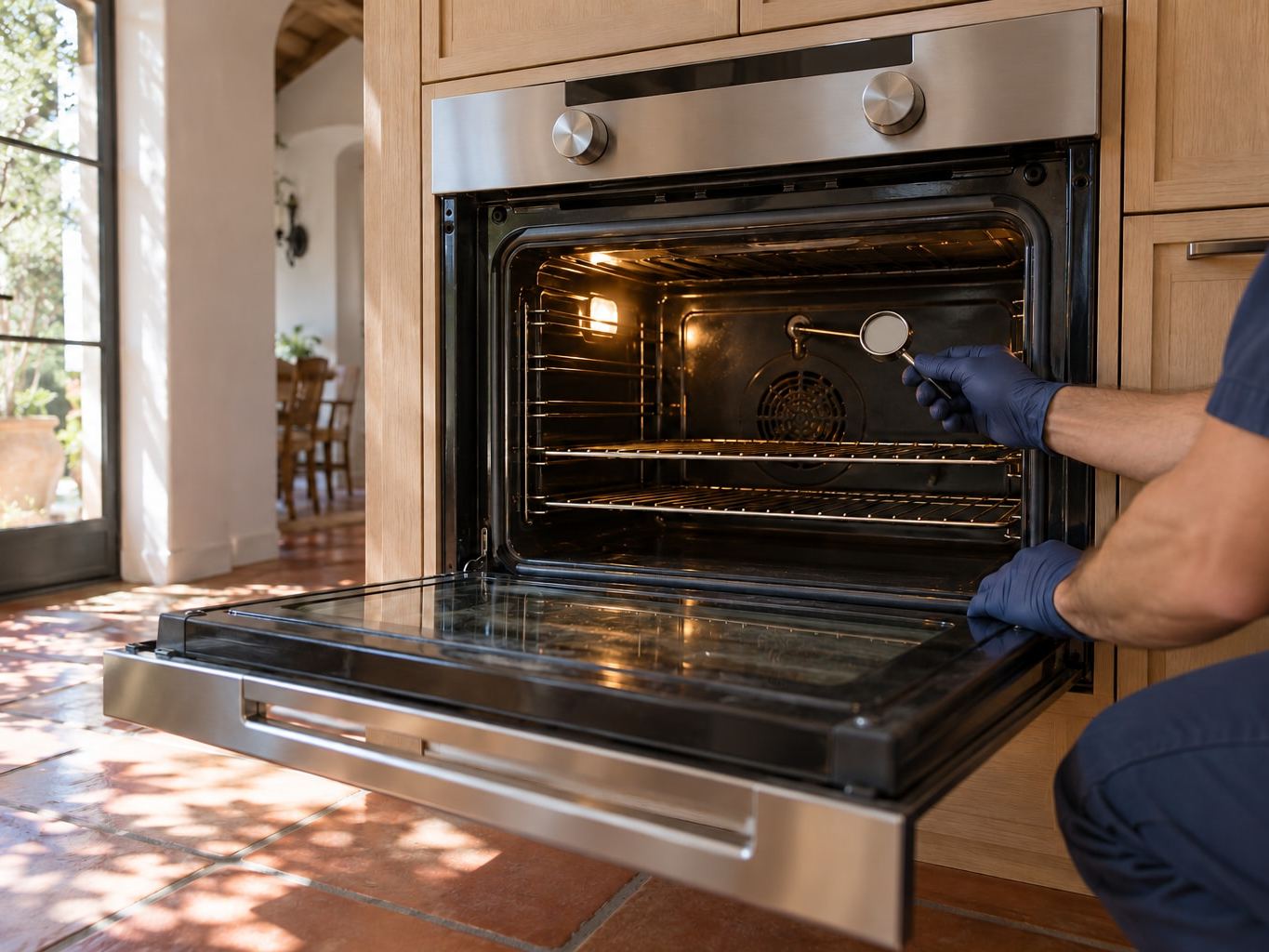
The technician hears your story first, then sets the oven on bake, on convection and on broil while a separate thermometer sits in the cavity.
-
Testing
Elements, probe and fan motor get measured with a meter; the board's outputs are checked; door, hinges and gasket are inspected.
-
Before any repair
You learn which system broke, which part, and the firm figure for the job. That $89 trip charge covers every appliance we glance at during the visit and is subtracted once you say yes.
-
The fix
Out comes the dead part, in goes its replacement. Parts that need ordering get a follow-up date fixed before we leave.
-
Before we pack up
The oven runs a full heat-up with the thermometer inside, and the fan is listened to.
Said plainly
Why is my Wolf oven temperature not accurate?
When the screen reads correctly yet food cooks fast or slow, suspect the temperature probe first — it drifts with age, or its plug works loose. Prove it by setting a standalone thermometer mid-rack and letting the oven preheat fully. A gap that repeats on several tries means the probe or board needs service; nudging the calibration offset only masks it.
Single wall oven or double: what changes
Both types use the same building blocks, but a double oven doubles some parts and shares others, and that changes how a fault looks.
Single wall oven
- One cavity with its own elements, probe and convection fan
- A fault shows up in the only oven you have, so it is obvious fast
- Lighter unit, easier to slide forward when the back has to be reached
- Self-clean stresses one set of parts
Double wall oven
- Two cavities, each with its own elements and probe
- Often one control panel and shared electronics for both
- If both ovens misbehave at once, the shared parts are the first suspect
- Heavier and taller, so reaching the back takes more care with your cabinetry
Our takeIf only one cavity of a double oven acts up, the problem is almost always in that cavity's own parts. If both quit together, look at what they share.
Five checks before you call
No screwdriver needed for any of these, and one of them may make our trip unnecessary.
- Look at the breaker panel: wall ovens sit on their own circuit, and a tripped breaker can leave the display alive while the elements stay cold
- Rule out a Sabbath or delayed-start setting someone switched on without meaning to
- Set a standalone thermometer on the middle rack, preheat all the way, and read it against the screen
- Wipe the touch panel dry and let it rest; moisture alone can freeze the controls
- Write down any fault message exactly as it appears, plus the model and serial from the oven's rating plate (the manual shows where to find it)
Said plainly
Who repairs Wolf wall ovens in Los Angeles?
LA Wolf Range Repair handles Wolf built-in ovens, single or stacked double, inside homes throughout thirteen LA neighborhoods, from Santa Monica to Sherman Oaks. We are independent and travel to you 8 AM–6 PM daily. The $89 visit covers the diagnosis, counts toward the repair, and the fixed price is agreed before work starts.
Wall oven questions we get asked
- How much is a Wolf wall oven repair?
- Our trip charge is $89, and it is deducted from the bill when you approve the fix. What the fix itself runs depends on which system gave out — swapping a probe and replacing an electronics board sit far apart — so the figure comes after testing, never before. The pricing page explains what drives it.
- My Wolf oven also has a steam oven next to it. Can you look at both?
- Gladly — still a single trip and a single $89. Steam ovens bring water-related faults of their own; the convection steam oven page covers them.
- My oven runs hot — can I keep cooking with it for now?
- For simple dishes you can compensate by watching closely, but an oven running well above its setting can overheat nearby cabinetry and electronics over time. Book the visit rather than living with it.
- Should I run self-clean to fix a smell or smoke?
- Only if the oven is otherwise working normally. If it is already misbehaving, a self-clean cycle can push a weak part over the edge. Clean by hand and call us first.
- Do you come to my neighborhood?
- Oven visits cover Los Angeles, Beverly Hills, Brentwood, Century City, Culver City, Encino, Hancock Park, Pacific Palisades, Santa Monica, Sherman Oaks, Studio City, West Hollywood and Westwood.