Cooking surfaces · LA
Wolf cooktop and rangetop repair
The cooking surface takes more daily punishment than anything else in the kitchen — splashes, scrubbing, cast iron dragged across it. Wolf builds that surface four ways: gas, induction and electric cooktops, plus the pro-style rangetop. Each wears out differently, so this page starts by sorting them, then walks through what goes wrong on yours.
4.8 of 5 from 187 reviews About our reviews
- Call 24/7(213) 652-7030
- Pick a daytime slotBook a visit
- Per visit, credited to the repair$89
- House calls, every day8–6
Said plainly
Who fixes Wolf cooktops in Los Angeles?
LA Wolf Range Repair is an independent, in-home service for Wolf gas, induction and electric cooktops and gas rangetops across thirteen LA neighborhoods, Westside to the Valley. The phone at (213) 652-7030 is answered 24/7. Kitchen visits are scheduled 8 AM–6 PM daily, sometimes that same day if the calendar allows, and our $89 call-out is deducted from whatever repair you okay.
Four Wolf cooking surfaces, side by side
Find your surface in the left column. If grates sit over flames and the knobs are on the top deck, it is a gas cooktop; knobs on a front panel mean a rangetop.
How each Wolf surface makes heat and where it tends to wear
| Surface | How it heats | Parts that wear | What owners notice |
|---|---|---|---|
| Gas cooktop | Sealed gas burners with spark ignition; knobs on the top deck; set into a hole cut in the counter | Electrodes, spark module, knob switches, burner caps and ports, valves | Ticking with no ignition, ragged or yellowish flames, a simmer that dies |
| Induction cooktop | Magnetic field from coils under glass heats the pan itself | Cooling fan, power boards, coils, touch controls, the glass top | A zone that won't detect the pan, a fan that roars or stays silent, shut-offs mid-cook |
| Electric cooktop | Radiant elements glowing under smooth glass | Elements, limiters, switches or touch controls, the glass top | A ring that never warms or never dials down, unresponsive controls |
| Gas rangetop | Pro-style gas burners in a unit that slides into the counter, knobs on the front, sometimes a griddle or charbroiler | Electrodes, spark module, front knob switches, valves, the extra burner under a griddle | Same ignition and flame faults as a cooktop, plus uneven griddle heat |
Said plainly
What is the difference between a Wolf rangetop and a cooktop?
A Wolf cooktop sits in a counter cutout with its knobs or touch controls up on the cooking deck, and comes in gas, induction or electric versions. A rangetop is gas only, slides into the counter so its front panel faces you like a range without the oven, and carries its knobs on that panel. Rangetops often add a griddle or charbroiler.
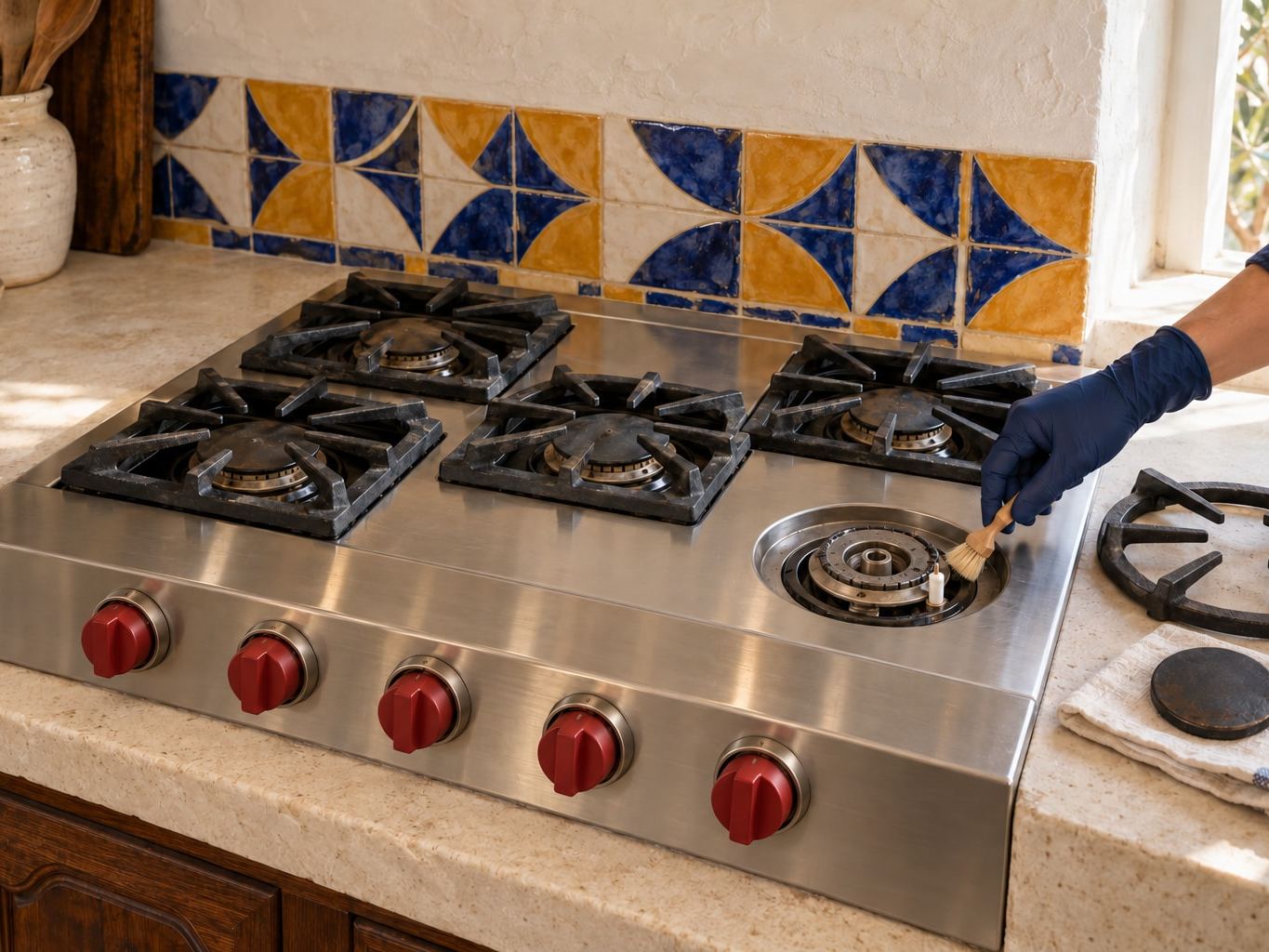
What breaks on each surface
Grouped by technology so you can skip to yours. The link on gas items leads to the range page, where the same burners appear in more detail.
-
You notice
Gas: one burner ticks endlessly after it has already lit
Usually behind it
Damp knob switch, usually after cleaning spray ran down the stem, telling the module the knob is still in the light position
Read the repair page -
You notice
Gas: flames hover above the burner head, or burn yellow and leave soot on pans
Usually behind it
Cap off its seat, ports clogged with burnt-on food, or a gas pressure problem that needs measuring
Read the repair page -
You notice
Gas: a sulfur or rotten-egg odor near the cooktop
Usually behind it
Not a repair question until the house is cleared — see the red warning below
-
You notice
Induction: the zone flashes and won't start, though a pan is on it
Usually behind it
Cookware a magnet won't grab, a pot undersized for the ring, or a coil and its driver board that have stopped noticing the pan
-
You notice
Induction: the surface shuts off on its own halfway through cooking
Usually behind it
Boards under the glass running hot — a tired cooling fan, or the air intake beneath the cooktop is choked
-
You notice
Electric: one element glows full blast at every setting, or stays dark
Usually behind it
A failed switch or relay, or an element that burned open
-
You notice
Rangetop: griddle hot in the middle, cool at the edges, or slow to come up
Usually behind it
A partly blocked burner or misadjusted flame under the plate
-
You notice
Any glass top: a chip, a split or a spiderweb of fine lines
Usually behind it
Something heavy landed on it; the top panel has to be replaced, and cooking stops until then
Smell gas? Out first
Gas in the air or a split in the glass? Step back
Two cooktop problems are safety problems first. Catch a whiff of gas and the drill is simple: hands off every knob, wall switch and thermostat, get out of the house with everyone else, and only from the street or yard dial the gas company's emergency line or 911. A cracked glass top is the other one: liquid can reach the live electronics underneath, so stop cooking on it entirely until the top has been replaced.
- Gas odor: no flames, no switches, no calls from inside the house
- Cracked glass: no cooking, no wiping liquid across the crack
- Ring us after the all-clear; fixing the cooktop is step two
Induction: the pan and the fan matter more than you think
Many induction calls turn out to be the cookware rather than the cooktop. Induction heats only pans a magnet will grip firmly on the base. Copper, aluminum, glass and some clad stainless pans are invisible to it, and a pan much smaller than the marked ring may not be recognized at all. Before booking, press a fridge magnet against the base of the stubborn pan, then try a different, clearly magnetic pan on the same zone.
The second common cause is heat. The power electronics under the glass work hard, and a fan pulls air across them through a gap below the cooktop. If a drawer directly underneath is crammed with towels or plastic containers, or the vent space was closed up during a remodel, the electronics overheat and the cooktop protects itself by shutting zones down. Clearing the space often fixes intermittent shut-offs.
A faint buzz or hum with certain pans is normal on induction and is the pan vibrating in the field. A loud grinding from under the cooktop, a fan that never seems to stop, or one zone that fails with every pan points to a fault inside, which we diagnose with the cooktop running. For a closer look at what is inside Wolf cooking equipment, see the engineering behind a Wolf, and when the hood above has lost its pull, head over to hood and ventilation repair.
Said plainly
Why is my Wolf induction cooktop not working?
First check the pan: a magnet must stick firmly to its base, and it should roughly fill the zone. Then check the breaker and clear anything blocking the airflow under the cooktop. If a zone still refuses a magnetic pan, shuts down mid-cook or the fan sounds wrong, a coil, power board or cooling fan has likely failed.
Cooktop questions, answered plainly
- How much should I budget for a Wolf cooktop fix?
- You pay $89 for us to come out, and that sum vanishes from the invoice once you green-light the fix. Beyond it, everything rides on the part: a spark electrode and a full glass top live in different universes. We quote after testing, and nothing is swapped until you agree. The pricing page shows what drives it.
- Can a cracked glass cooktop be repaired, or only replaced?
- The glass itself cannot be patched safely. The top panel is replaced, and the burners, coils or elements underneath are usually reused. Until then, don't cook on it.
- Do you work on my neighborhood's cooktops?
- Cooktop and rangetop visits cover Los Angeles, Beverly Hills, Brentwood, Century City, Culver City, Encino, Hancock Park, Pacific Palisades, Santa Monica, Sherman Oaks, Studio City, West Hollywood and Westwood.
- If I also have a Wolf oven acting up, is that another charge?
- Nope. The $89 pays for us showing up, so the oven, the hood and the cooktop all ride on that one visit.