Outdoor grills · Los Angeles
Wolf Grill Repair for Life Outdoors
Your Wolf range sits in a kitchen with a roof and steady air. Your Wolf grill spends its life under hard sun, damp ocean mornings, Santa Ana grit and the occasional winter storm, and most of its failures trace back to that exposure. The good news: weather damage on a Wolf grill is usually repairable, piece by piece.
4.8 of 5 from 187 reviews About our reviews
- Call 24/7(213) 652-7030
- Pick a daytime slotBook a visit
- Per visit, credited to the repair$89
- House calls, every day8–6
Smell gas? Out first
Gas smell at the grill? Step away first
If you catch the odor of gas around the grill, keep your hands off the knobs, the igniter button and the cylinder, and strike no flame of any kind. Herd guests, kids and dogs off the patio, and if the odor has reached the house, get out of the house too. From the sidewalk or a neighbor's yard, ring 911 or your gas utility's emergency line; our repair call comes later, after the leak is dealt with.
- Searching for the leak with a lighter flame is never an option.
- Leave patio lights, outdoor outlets and pool equipment switches alone near the grill.
- Keep children and pets back until the gas company says the area is safe.
Said plainly
Who fixes Wolf outdoor grills in Los Angeles?
LA Wolf Range Repair repairs Wolf outdoor gas grills, built into an outdoor kitchen or standing on their own cart, across the thirteen LA neighborhoods we serve. Ignition, burners, valves, heat output and corrosion damage are all part of the job. Getting a technician to your patio costs $89, an amount later subtracted from the repair invoice, and you approve the repair figure up front. Phone (213) 652-7030 or schedule online.
What the grill is showing you
Grills tend to fail in recognizable patterns. Match yours to a line below and you have a head start on the diagnosis.
-
You notice
The igniter clicks, yet no burner catches
Usually behind it
No gas arriving: an empty propane tank, a propane regulator whose safety feature has throttled the flow, or a supply valve on the natural gas line left closed after other work
-
You notice
Press the igniter and there is no click whatsoever
Usually behind it
A flat battery, where the model runs its spark from one, or an igniter wire and electrode corroded by damp, salty air
-
You notice
One burner refuses to light while its neighbors fire normally
Usually behind it
Spider webs or insect nests inside that burner's tube, clogged ports, or an electrode bent sideways by an enthusiastic grate scrubbing
-
You notice
Flames look tall, lazy and yellow, and the grates collect soot
Usually behind it
The air and gas mixture is off, typically a burner tube half-choked by debris or a web
-
You notice
Flame shows up behind the knobs or beneath the front panel
Usually behind it
Flashback: gas burning inside an obstructed burner tube. Put the cooking on hold until someone inspects it
-
You notice
One end sears, the opposite end barely browns
Usually behind it
Rusted or grease-clogged burner ports, a warped burner, or flame shields that have burned through
-
You notice
Knobs feel stiff, gritty or will not turn
Usually behind it
Dirt and corrosion in the valve area. Forcing them can damage the valve, so leave them for the technician
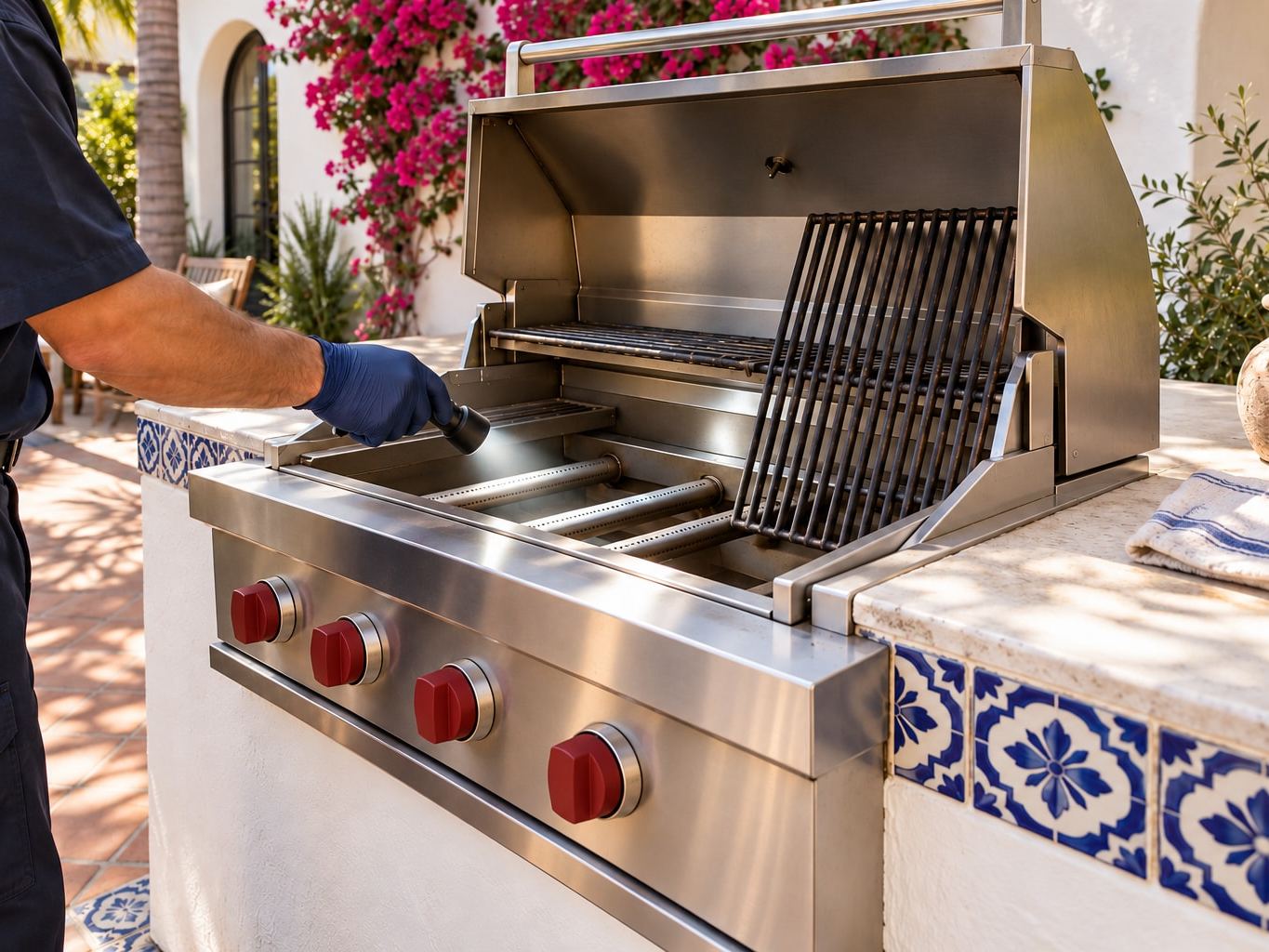
First cookout after a long break: a safe start
A grill that has sat through a rainy winter or a busy summer away earns a once-over before anything hits the grates. Follow these in order.
-
Lift the cover and look inside
Check the firebox, the burner area and under the grates for leaves, nests, ash and standing water. Clear out anything loose by hand.
-
Inspect the hose and connections
On a propane grill, look over the hose for cracks or stiffness and make sure the tank connection is snug. On natural gas, confirm the supply line has not been bumped by gardeners or pool crews.
-
Run a soapy water test
Brush a mix of dish soap and water over the hose and fittings, then slowly open the supply. Growing bubbles mark a leak; shut the supply back, leave the grill cold and phone for service.
-
Raise the lid before lighting
Always ignite with the lid up, so gas cannot collect under it, then fire the burners individually as the label inside the lid or the manual describes.
-
Watch the flame
Healthy burners show an even blue flame with small yellow tips along their length. Gaps, lifting flames or a yellow, smoky fire tell you a burner needs attention.
-
Preheat and listen
Close the lid, let it come up to temperature and check that the thermometer climbs steadily. Popping, roaring or a whistle are clues to pass along when you phone.
Said plainly
Why won't my Wolf grill light?
If it clicks without catching, fuel is failing to make it to the burner: check the propane level or the natural gas supply valve. If it does not click, suspect the igniter battery or a corroded wire. If only one burner fails, an insect nest or blocked ports in that burner are the likely cause. Anything beyond that calls for a technician's visit.
Coast against Valley: one grill, two kinds of wear
Across Los Angeles the same Wolf grill ages differently depending on what blows across the patio. These are the patterns the local climate tends to produce.
-
Santa Monica and Pacific Palisades
The marine layer leaves a salty film on everything most mornings. Igniter wires, fasteners and hinges corrode first, and stainless panels pick up rust-colored tea staining unless they are rinsed regularly. See Santa Monica and Pacific Palisades.
-
Brentwood, Westwood and Culver City
Gray mornings that burn off by afternoon mean dew collects under covers and then bakes off. Moisture trapped beneath a cover is a quiet cause of rusted burners. See Brentwood, Westwood and Culver City.
-
Encino, Sherman Oaks and Studio City
Valley summers run hot and long, and many grills there work near a pool almost every weekend. Heavy use plus strong sun dries out knobs, gaskets and control panels faster. See Encino, Sherman Oaks and Studio City.
-
Beverly Hills, Hancock Park and West Hollywood
Mature trees shade many yards and patios, which is pleasant until leaves, seed pods and pollen settle into burner boxes and drip trays. See Beverly Hills, Hancock Park and West Hollywood.
-
Hillside homes, high-rises and the wider city
On canyon lots and exposed terraces, Santa Ana winds push grit into valves and can blow out low flames. See Los Angeles and Century City.
An LA grill year, season by season
Southern California lets you cook outside in every month, so the grill never really gets an off season. Here is what each stretch of the year tends to do to it.
-
Winter rains
The few big storms of the year soak covers and firebox floors. Afterward, check for standing water and rust on burners before the next cookout.
-
Spring bloom
Pollen, blossoms and insects move in. Spiders like the quiet, dark burner tubes, which is why spring is when one-burner lighting problems often appear.
-
May Gray and June Gloom
Weeks of overcast, damp mornings near the coast. Let the grill dry uncovered on sunny afternoons and wipe salt film off the stainless.
-
Peak summer
Long cookouts and holiday parties push burners and valves hardest. Our article on entertaining with your Wolf covers heavy-use weeks indoors and out.
-
Santa Ana season
Hot, dry winds carry dust and ash into every opening. Brush out the burner area after a windy spell, and read how LA's climate affects your Wolf through the year.
-
Holiday stretch
Cooler evenings, more guests and a grill that has worked all year. A good moment to schedule a look before family arrives.
Grill beliefs worth unlearning
-
You may have heard
Stainless steel cannot rust, so a stainless grill is weatherproof.
What actually happens
Stainless resists rust, but salt air near the ocean still causes surface staining and pitting, and the steel screws, wires and burners inside it corrode faster than the shell.
-
You may have heard
A grill cover keeps the weather out, so it should stay on all the time.
What actually happens
A cover keeps off dust and leaves, yet it also traps fog and dew against the metal. Covering only a dry, cool grill and letting it air out after damp spells does more good.
-
You may have heard
No ignition means the igniter is broken.
What actually happens
More often the gas is not arriving, the battery is flat or a wire is corroded. Replacing the igniter blindly can cost you a part you never needed.
-
You may have heard
Bigger, yellower flames mean more heat.
What actually happens
Proper combustion looks blue, with only small yellow tips. Tall yellow flames waste gas, deposit soot and point to a blocked or misadjusted burner.
Said plainly
Why is my Wolf grill not getting hot enough?
Low heat usually comes from restricted gas flow or poor burners: a propane regulator in low-flow mode, partly blocked burner ports, a grill converted between propane and natural gas without matching parts, or strong wind across the firebox. A technician checks pressure, burners and fittings and tells you the repair price before starting.
Grill questions from LA owners
- Do you repair Wolf grills built into an outdoor kitchen island?
- Yes. Built-in grills are reached through the access doors or panels in the island, so it helps if nothing is stored tight against them when the technician arrives.
- My Wolf grill runs on propane. Do you work on those as well as natural gas grills?
- Both. The fuel type matters for diagnosis, because propane and natural gas use different regulators and burner orifices, so tell us which you have when you book.
- Will I pay $89 twice if the technician checks my indoor Wolf too?
- No. The charge belongs to the trip, not to each appliance, so the patio grill and, say, your kitchen hood share a single fee. Whatever you approve afterward has that amount deducted.
- Can you get to my grill today?
- If the route for the day still has a gap, yes. Someone picks up the phone 24/7; technicians are out 8 AM–6 PM daily. Dial (213) 652-7030 or choose a slot online.
- How will I know what the repair costs?
- Once the grill has been examined, the technician names the price of the fix, and work waits for your yes. Our pricing page breaks down what moves that figure.
- Should I keep my grill covered if I live near the beach?
- Cover it only when it is cool and dry, take the cover off on sunny afternoons to let trapped moisture escape, and rinse or wipe the stainless now and then to remove salt film.
- My older Wolf grill has some rust. Is repair still sensible?
- Often it is, because burners, igniters, valves and many trim parts can be replaced while the body is still sound. Should a needed part be discontinued, you hear it from us before any money changes hands.